Quick Connect: 844.COFC.911

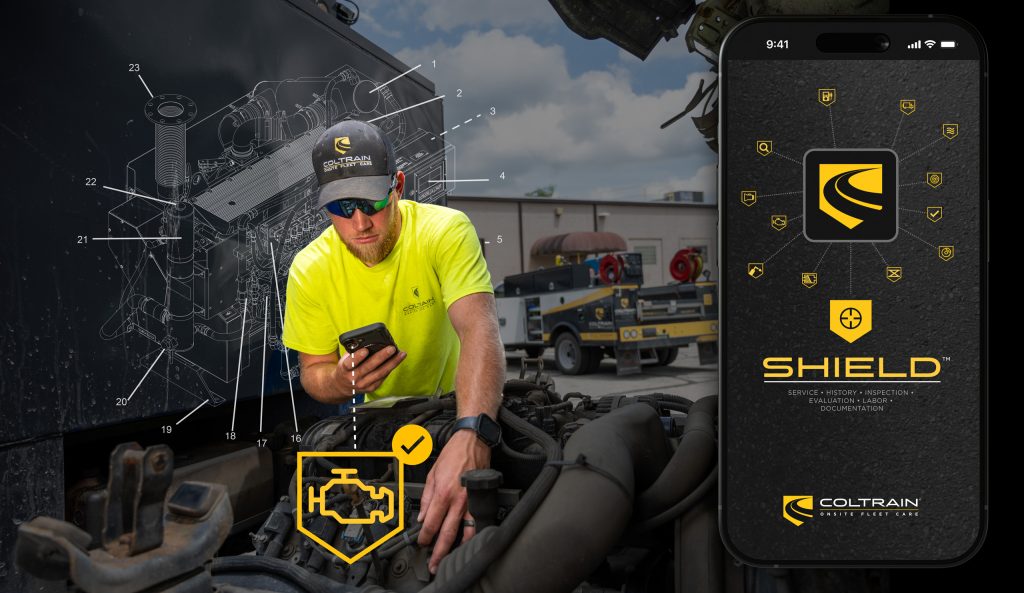
Fleet managers know the drill. A technician finishes a preventive maintenance service, signs a paper form, and a PDF lands in an inbox, if it arrives at all. But what did they actually measure? Did the brakes fall within spec? Who did the work? An electronic PM inspection should answer every one of those questions on the spot. Most inspection tools still don't.
For years, mobile maintenance has run on a trust-and-hope model. “There is a level of trust that fleet managers need to put in the technicians, because they don't know,” says Kyle Coltrain, Co-Founder of Coltrain Onsite Fleet Care. “They're trusting our technician, or their vendor's technician, to do the repair the right way.” That trust has rarely come with much to back it up. A checkmark on a form says almost nothing about the equipment's actual condition.
That gap creates real problems. Coltrain Onsite Fleet Care built SHIELD™ to close it.
Why Every Fleet Needs an Electronic PM Inspection Process
Mobile maintenance is one of the fastest-growing segments in commercial trucking, and for good reason. On-site service cuts downtime. It keeps trucks on the road. It also reduces pressure on in-house shop capacity. Yet the tools used to manage that service haven't kept pace with its growth.
“Nine times out of ten, companies are still using pen and paper or an off-the-shelf tool,” Kyle Coltrain says of the broader mobile maintenance industry. Some competitors do run field service apps, he's quick to add, but a digital tool isn't automatically a useful one. “Data is irrelevant unless it's organized and actionable.” A completed form, digital or not, often gives a fleet manager almost nothing to verify. What did the technician measure? What did they find, and what, if anything, did they fix?
The consequences show up later. Technicians miss inspection points. Service quality varies from stop to stop. Compliance gaps widen. According to the Commercial Vehicle Safety Alliance's 2025 International Roadcheck, roadside inspectors placed approximately 18 percent of inspected vehicles out of service. Brake-related violations accounted for roughly 41 percent of those failures. A truck can fail a DOT inspection weeks after a PM service. When that happens, the question of what the last inspection actually caught is nearly impossible to answer without a real record.
Audits make the gap even more obvious. A compliance officer asks for proof of the last six PM services. A stack of scanned paper rarely holds up the way a structured digital record does. Nobody can reconstruct missing measurements after the fact, and a technician's memory of a three-month-old job isn't a substitute for a logged value.
An electronic PM inspection closes that gap. It captures the right data, in the right format, at the point of service, and makes it available immediately to the people who need it.
Introducing SHIELD: What the Acronym Stands For
SHIELD™ is Coltrain Onsite's proprietary field service application. The name breaks down into what it captures: Service, History, Inspection , Evaluation, Labor, Documentation, all tied to one time-stamped record.
Two users shaped the design: the technician performing the work, and the fleet manager reviewing it afterward. For technicians, SHIELD extends the normal inspection workflow instead of interrupting it. It's simple enough to learn in a day and reliable enough to trust on every job. For fleet managers, it delivers something mobile maintenance has rarely offered: documented proof of work, tied to a specific unit and a specific technician, available in real time.
Every completed SHIELD Report links to the unit's VIN, the date of service, and the name of the technician who performed the inspection. That creates an unbroken line of sight from the technician in the field to the fleet manager reviewing the record.

What an Electronic PM Inspection Should Actually Capture
Not every digital checklist qualifies as a real electronic PM inspection. A form on a screen isn't automatically better than one on paper. The actual difference between SHIELD and a traditional inspection sheet is depth, not format. Internally, Coltrain Onsite calls it a 100-point inspection, meaning every point on the checklist gets accounted for and time-stamped rather than skimmed over. The exact count varies by unit and service type, since some points don't apply to every truck.
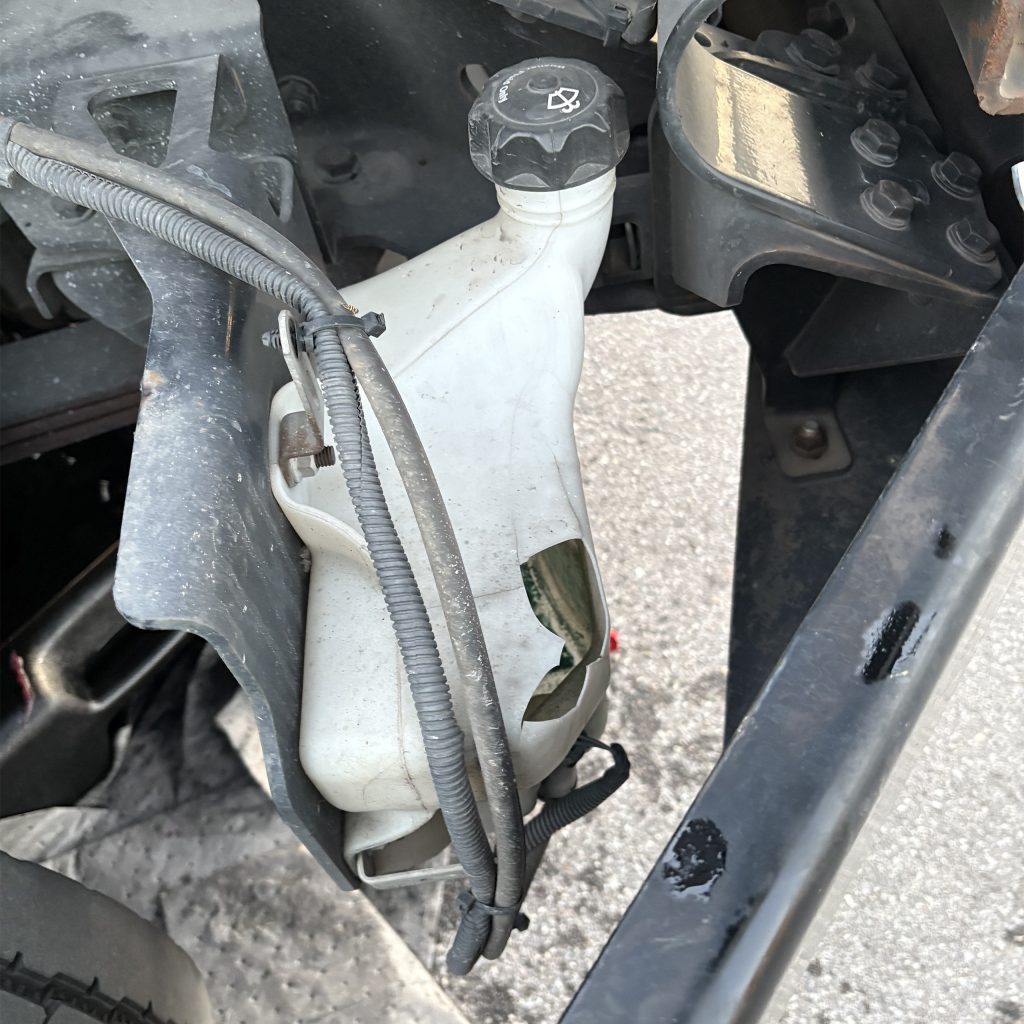
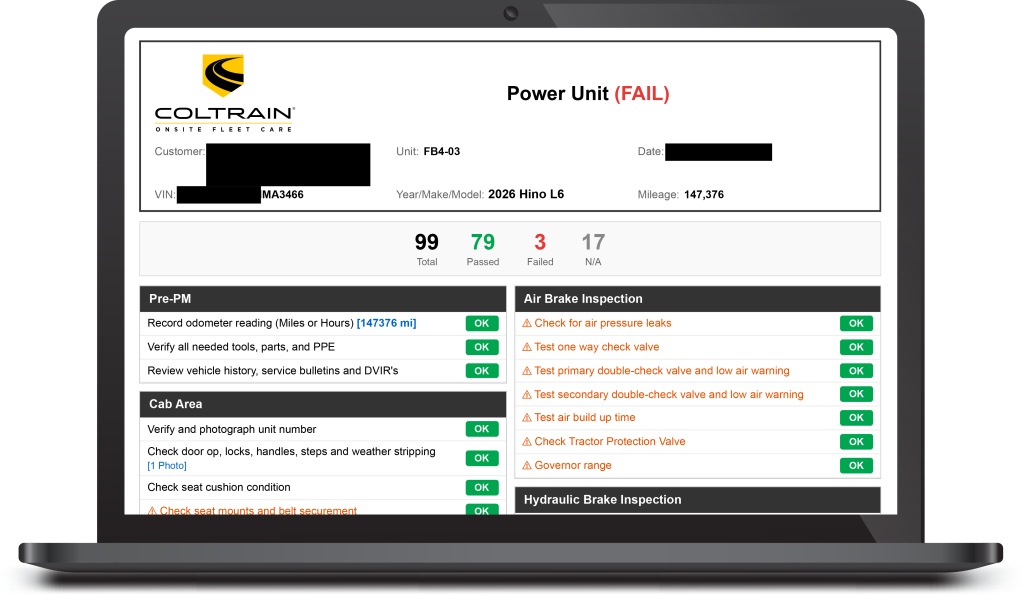
Conventional forms record a checkmark. SHIELD logs the number behind it. Tire PSI, tread depth, brake measurements, and steering play all show up as real values, not pass-or-fail flags. On one recent Coltrain Onsite PM inspection of a Class 8 tractor with 147,376 miles on the odometer, the report ran 99 separate checkpoints: 79 passed, 3 failed, and 17 marked not applicable. The technician logged tire PSI at all ten positions, from 95 PSI on the steer axle to 100 PSI across both drive axles. Tread depth got measured position by position too, from 12/32 of an inch up to 25/32. The report captured brake lining thickness and push-rod stroke at all six brake positions too, instead of lumping them into one pass-or-fail line. Three items failed that day: a cracked windshield washer reservoir, and a cracked flatbed frame flagged under federal motor carrier safety regulations. Each one came with a technician's note and a timestamped photo attached directly to the record. Those are numbers and images a fleet manager can act on, not a shrug.
Photos accompany the data at every stage, building a visual record alongside the measurements. Together, they serve several purposes at once. They give fleet managers what they need to make informed maintenance decisions. They also support DOT compliance and audit readiness. Over time, they build a service history for each unit, which makes wear patterns visible before those patterns become failures.
For fleets running large or distributed operations, this kind of documentation isn't optional anymore. It's the baseline for responsible fleet management, and SHIELD sets that baseline as the default.
Built for the Technician, Delivered to the Fleet Manager
Software teams often build field service technology for the back office first and the technician second. That approach backfires. Complex interfaces and redundant data entry slow technicians down, and a slower inspection is rarely a better one. That failure mode isn't hypothetical in mobile maintenance, either. An app that takes longer to navigate than the inspection itself pushes technicians to route around it. The fleet manager ends up back where they started: a form with gaps in it.
SHIELD flips that priority, and the result is an electronic PM inspection built around the person actually doing the work. Inspection forms load automatically based on service type, and each section mirrors the physical flow of the inspection itself. Technicians can't submit an incomplete PM. The application requires technicians to address every inspection point before a report finalizes, so no one skips a step and every record stays complete.
Support stays close to the work, too. Because Coltrain Onsite built SHIELD in-house, the team behind the technology stays directly accessible to the technicians using it every day. That team identifies and fixes issues fast, without ticketing queues or committee reviews slowing things down.
What reaches the fleet manager, in the end, is a clean, time-stamped service record. Every inspection point, every measurement, every photo, gets organized by unit and by technician.
SHIELD also catches shortcuts that most inspection tools miss. Every inspection point gets its own timestamp. If a step that should take 30 minutes gets logged in 30 seconds instead, the system flags it and notifies the manager. Photos get the same scrutiny: if there are reused images from a previous inspection instead of taking new ones, SHIELD detects the duplicate and flags that too.
SHIELD and the Coltrain Onsite Commitment to Quality
Coltrain Onsite Fleet Care runs on a simple idea: fleets deserve a mobile maintenance partner they can actually verify, not just trust on faith. SHIELD puts that idea into practice.
Every SHIELD Report carries the name of the technician who performed the service, and that's intentional. Coltrain Onsite runs as a technician-first organization, so the accountability built into SHIELD runs in both directions. Customers get to know who worked on their equipment. Technicians get to stand behind work that holds up to scrutiny. “This is how we quality control our technicians,” Kyle Coltrain says of that sign-off. “This is how we ensure technicians aren't pencil whipping it.”
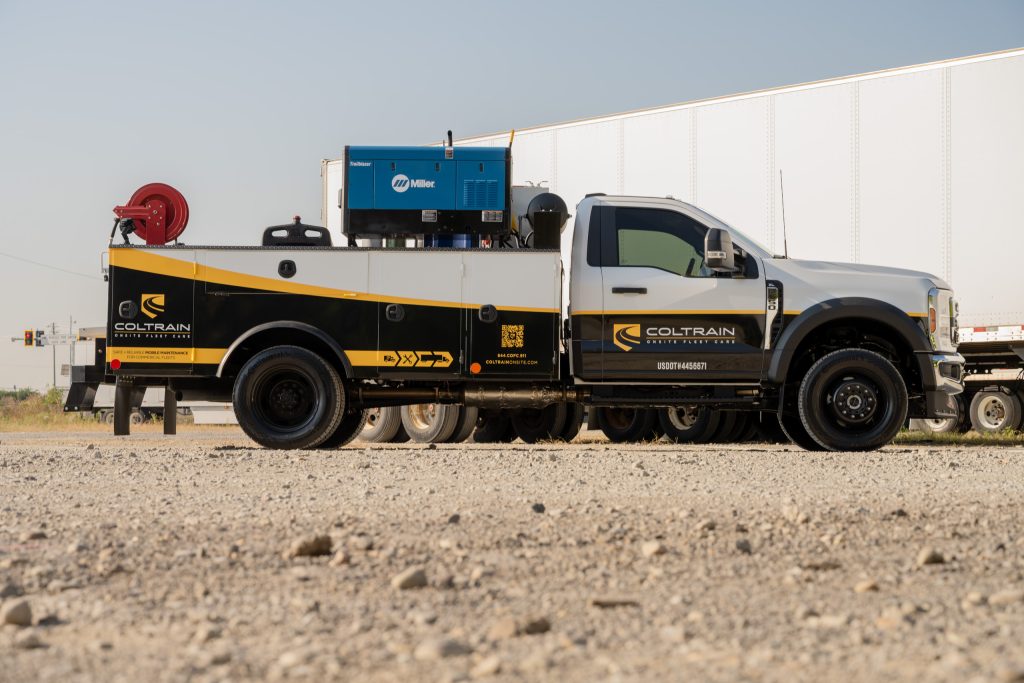
SHIELD runs across all 15 states in Coltrain Onsite's footprint today, alongside a team of more than 100 professionals, 75 of which are mobile technicians. Every completed inspection adds to that record: a fleet vehicle that received documented, verifiable service, and a fleet manager who no longer has to guess what actually happened.
Questions to Ask Your Mobile Maintenance Provider
A few questions separate a documented PM service from a signature on a form. If your current provider can't answer these about the last service call, it's worth asking why.
What specific measurements did the technician record at each inspection point? What photos document the unit's condition at the time of service? Who performed the inspection, and when did they finish it? How does the process stop an incomplete inspection from reaching your inbox as a finished report? Where does the record live, and how long does it stay on file?
These aren't unreasonable expectations. They're the baseline for accountable mobile fleet maintenance, and an electronic PM inspection process is what makes that baseline achievable on every service call.
Confidence in Every Repair. Defend the Road.
Mobile fleet maintenance has a documentation problem, and Coltrain Onsite is closing it one verified inspection at a time. SHIELD™ is live today across Coltrain Onsite's service network, already built into every preventive maintenance call the company runs. To see how an electronic PM inspection works on your fleet, to confirm coverage in your area, contact Coltrain Onsite.
MORE ARTICLES
7 Things Fleet Managers Should Know From Coltrain Onsite’s Fleet Management Weekly Feature
Coltrain Onsite Fleet Care Press Coverage Roundup
